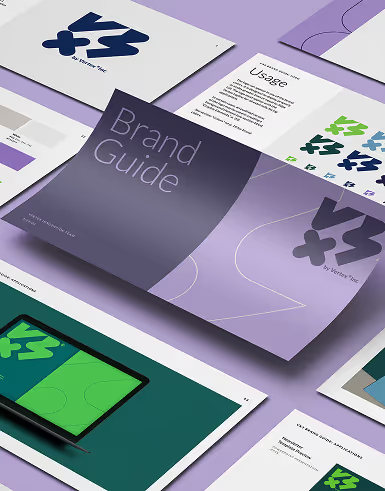
Design and branding are essential elements of any business. A well-designed and branded company will be more recognizable to customers and can help set your business apart from the competition. In this guide, you'll learn how to design and brand your company to reflect the personality of the business. You'll find tips on strengthening the visual aspects of your business by choosing colors, fonts, and logos and creating a style guide to keep your branding consistent.
Note though that when it comes to creating a strong and recognizable brand, there's more to it than just choosing the right colors and fonts. Your brand guidelines should also include detailed instructions on how to use your logo, what tone of voice to use in your messaging, and what type of imagery works best with your brand. This may appear to be a lot of work, but it will pay off in the end.

Having clear brand guidelines helps ensure that everyone involved in promoting your business is on the same page, making for a much more cohesive and effective branding strategy overall. So, if you're ready to take your branding to the next level, be sure to create some comprehensive brand guidelines. Your business will thank you for it!
This article will focus on creating a strong visual identity for your company. We'll discuss choosing colors, fonts, and logos that reflect the personality of your business and creating style guides to keep your branding consistent. By the end of this guide, you'll have all the tools you need to create a cohesive and recognizable brand for your business.
Why Create a Strong Visual Identity?
Creating a strong visual identity for your company is vital for several reasons. First, it helps customers recognize your brand. A well-designed logo, for example, can be an important part of customer recognition. According to a study by the University of Pennsylvania, people are able to remember logos better than they remember the names of companies.
Second, consistent branding makes your company look more professional and trustworthy. Customers are more likely to do business with a company that appears to be well-established and credible. On the other hand, inconsistent branding can make your company look amateurish and untrustworthy. Experts found that poorly designed websites can make a company appear unprofessional and may lead to lost sales.
In addition, a strong visual identity can help set your company apart from the competition. If your company has a unique design or branding, it will be more memorable to customers and may convince them to choose your business over a competitor's.
Finally, a well-designed and branded company sends a message to customers that you take your business seriously and are committed to providing a high-quality product or service.
How to Design and Brand Your Company
The importance of design and branding to any business cannot be ignored. A well-designed logo and brand identity can help customers to remember your company, and strong visuals can convey the quality of your products or services.
However, design is only one part of branding. Your brand should also be reflected in your company culture, values, and mission. In other words, your brand is more than just a visual identity - it's a reflection of who you are as a business. By keeping this in mind, you can ensure that your branding efforts are holistic and achieve the desired results.
In this section, we focus on critical factors to consider in strengthening the visual aspects of your branding. These include the following:

Choosing Colors
One of the first things you'll need to decide when designing your company's branding is what colors to use. The colors you choose should reflect the personality of your business. For example, if your company is fun and energetic, you might want to use bright, vibrant colors. If your company is more serious and professional, you might want to use darker, more subdued colors.
There are also some general guidelines you should follow when choosing colors. First, it's essential to choose colors that work well together. You don't want to use a color that clashes with your logo or other branding elements. Second, you should consider the meaning of colors. For example, red is often associated with excitement and passion, while green is often associated with health and nature. You'll need to decide what meaning you want your colors to communicate to customers.
Finally, you should make sure that your colors are easy to read. Dark colors can be difficult to see on a website or in print materials, so you might want to use light colors for text or background images.
Choosing Fonts
Another important consideration when designing your company's branding is the type of fonts you use. Again, you'll want to choose fonts that reflect the personality of your business. For example, a fun and playful business might want to use fun and playful fonts, while a more serious and professional business might want to use more subdued fonts.
There are also some general guidelines you should follow when choosing fonts. First, make sure the font is legible. You don't want customers to have difficulty reading your text. Second, consider the meaning of different fonts. For example, serif fonts are often associated with traditional businesses, while sans serif fonts are often associated with more modern businesses.
Finally, you should ensure that the fonts you use work well together. You don't want to use a font that clashes with your logo or other branding elements.
Designing Your Logo
Your logo is one of the most important elements of your company's branding. It's the first thing customers will see, and it will often be the first thing they remember about your company.
When designing your logo, you'll need to consider several things. First, you'll need to decide what type of logo to use. There are several different types of logos, and each has its own strengths and weaknesses. Second, you'll need to decide what colors to use. As we discussed earlier, you should choose colors that reflect the personality of your business. Third, you'll need to choose a font for your logo. As with fonts, you'll want to choose a font that reflects the personality of your business. Fourth, you'll need to decide on a graphic or image for your logo. This graphic should be simple and easy to remember.
Finally, you'll need to make sure that your logo is easy to read and understand. A complex or confusing logo will only make it harder for customers to remember your company.
Creating a Slogan or Tagline
Another important element of your company's branding is a slogan or tagline. This short phrase summarizes what your company does or what it stands for.
Your slogan should be easy to remember and easy to understand. It should also be relevant to your company's products or services. For example, if you sell environmentally friendly products, your slogan might be "The greenest company in the world."
Your slogan should also be unique. You don't want to use a slogan that another company is already using. This will only make it harder for customers to remember your company.
Finally, your slogan should be consistent with the rest of your branding. For example, if you have a fun and playful logo, your slogan should be fun and playful as well.
Creating a Branding Strategy

Design and branding are essential components of any business, large or small. When done well, they can communicate your company's values and give customers a sense of what you're all about. But how do you create a design and branding strategy that will achieve these goals?
A branding strategy is a plan for how you want to present your brand to the world. Your branding strategy should include a description of your company's personality and how you want to communicate that personality to customers.
The first step in creating a branding strategy is to define your audience. Who are your marketing efforts aimed at? Once you know who your target market is, you can start to develop design and branding guidelines that will appeal to them. This might include developing a logo, choosing specific colors and fonts, and creating other visual elements that reflect your brand identity.
Of course, your branding strategy won't be complete without a plan for essay conclusion and how to get your message out there. You'll need to consider which channels - such as social media, print advertising, or email marketing - will be most effective for reaching your target market. With a little planning and creativity, you can develop a design and branding strategy that will help your business stand out from the competition.
Creating a brand is not a short-term process. Creating a brand that customers will love and remember takes time and effort. But if you follow these basic principles, you'll be on the right track.

Krisana is a journalist turned SEO Content Writer with keen interest in tech, software, and innovations. She is an avid fan of Elon Musk and wants to be part of the future Human Mars Mission. In the meantime, she spends her time researching and writing about everything that could make life a better place on Earth. Outside of work, Krisana dedicates her time with her two lovely kids.